Datura stramonium
(stra-MO-nee-um)
Datura or Jimson Weed
 To some, this plant has been cultivated in their gardens because of it's beautiful white upright trumpet flower. It can be as large as five inches across. They begin to bloom by mid-season and continue until frost.
 It is a wonderful self seeder of which literally hundreds are produced. Poor soil, full sun, a fair amount of water and it will be a show stopper.
It is probably a weed to most and I declare it as such, given it's common name. However, one would not expect such a glorious display from a weed. It is also known as the "downy thorn apple".
It can be invasive in a pasture or field situation.
Grow it once and you will be growing it again and making quite a statement. It is hard to find a catalogue source because it mainly is a passalong. Pass the seed rather than the plant because the plant may be hard to transplant with it's taproot.
Propagation
You can safely plant the datura seeds in the spring. Water well so they will germinate and in 3-4 weeks you should see little seedlings. They do grow large and you may want to thin out later on. Slight fertilizing once the plants get to be 6 inches or so.
Poisonous
(See below)
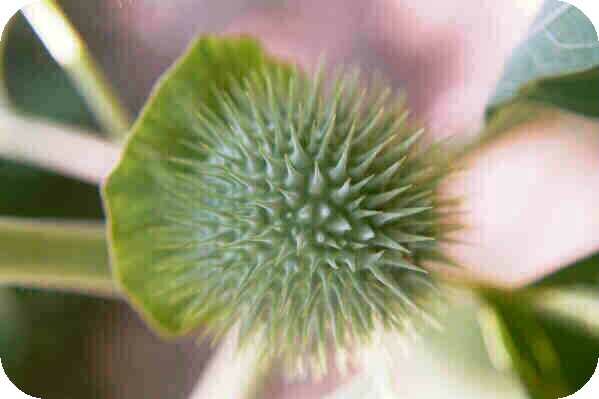
Seed Pod
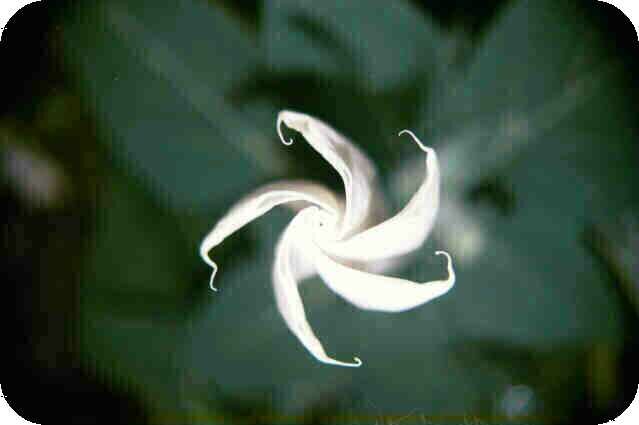
In the process of opening
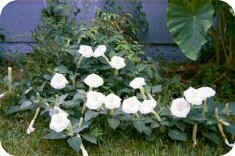
In bloom
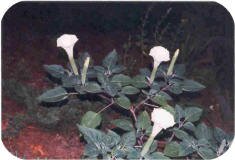
In the evening

Emily: I am sending you some pictures of my purple Datura
It has double and single blooms on the same plant. They have been and are still just beautiful. I live in San Antonio, TX.
My seed pods do not look like the ones I have seen on the web I do have mine in a pot and did take it in the garage during a freeze last December.
Enjoy the pictures.
Freida Wright


Emily: Datura stramonium is used in South American rituals
as a hallucinogen. It is mentioned in 'The Travels of Don Quixote' by Carlos Castenada as one of a two part mixture ... the other being Aconite, which was known a 'witches flying ointment'


I live in central Arkansas and this is my first year to have a double purple angels trumpet which my Mother bought me. All tho small it has put out loads of flowers.
Three Photos by PJ Howard

Emily: I moved to Spain and my datura doesn't bloom!
Dear Emily: When I lived in south west France my datura angel trumpet flowered very well every year. Now I am in Spain and my datura bought in April as container plants about one and half feet high both have grown well with good branches but no flowers. What can I do please?
A: Plants to not bloom for a variety of reasons.
- Too hot
- Too much water
- Too little water
- Lack of nutrients.
- With a cold spring and this may put it in some stress.
- Too much nitrogen in the fertilizer.
I would try and get a fertilizer that has a high middle number.
Something like 10-60-10. I believe Shultz has this is a water-soluble form.

Emily: What does the seed pod look like?
Dear Emily: I have recently received a Stramonium (Datura) White Angel's Trumpet seeds like that shown on your web site: at least I think it is the seed? It is a spiked round globe that has a collar and stem...I am hoping to plant this spiked globe and have it turn into a Stramonium plant. Is this the seed? Do I need to open it up slightly before planting it? What are the conditions it needs when planted. What does it look like when it first sprouts?
 A: Yes, what you describe is exactly the seed. It should be brown and mature for the seed to germinate in the spring. I would save them in a dry airtight container. Or open the pod and spread on a paper towel and get them dry. The pod does not get planted. It is amazing such a tiny seed will make such a big plant.
Then in the earliest spring after the frost I would sprinkle the seeds in the desired area. Full sun/not particularly great soil/ and plenty of room. One seed makes a HUGE pant.
With one pod of seeds you will have much to share.
When the plant first sprouts it will have oval leaves and they will be a little fuzzy.
Already I am looking for new areas to try the seeds. This is a 'wow' plant so I am going to try for the frontage of the buildings.
Emily: How poisonous is it?
Dear Emily: Would you tell me what kind of reaction one has when exposed to the datura plant if its so poisonous?
A: Datura contains toxic alkaloids hyoscyamine, atropine, and acopolamine, which make up about 0.3 peer cent of the dry weight of the plant. All parts of the plant, particularity the seeds , are poisonous. Children have been poisoned by eating the fruit or sucking the flowers. It has been called a "cow-killer."
Reaction??? Constriction.
Cats and dogs have a 6th sense to stay away from the plants. Adults should be know better, but children are hard to capture in a garden. So........ being responsible in planting this plant is always recommended.
Amy Stewart has an entire chapter devoted to this plant in her book, "Wicked Plants."
Tip: Plants that have been started from seed and have matured to a nice size fair better in the garden.