E-mail to Emily

Home

Composting
Houseplants
Pests of all Kinds
Landscape
Garden
Roses
Christmas
FAQ

Plants of the Week

Wildflowers and Weeds of the Week

Articles
Bookworms
Seed Exchange
Photography

Who's Who in Gardening
What's Growing On

Quotes
Master Gardening
Gardening with Kids

Selected Links

Backyard Wildlife Habitat
Can You Identify This?
Garden Glossary
A Gardener's Garden

Emily (who we are)


emilycompost
Plants

Kalanchoe daigremontiana
(kah-LAN-cho)
Mother of Thousands
CRASSULACEAE

Kalanchoe daigremontianaWhat a fun and delightful plant for children as well as adults.

This kalanchoe is one of 130 species of which there are annuals, biennials, and perennial succulents. The Mother of Thousands is a perennial, sometimes also called the Devil's Backbone, or Mexican Hat Plant. The "babies" are adventitious plantlets on the toothed margins of the leaf.

This plant can live for years and grow to three feet but it is a good idea to renew the often leggy plant with the newer plantlets. They tend to get top heavy.

Kalanchoes bloom when pot bound in the summer and fall and have no real fragrance.

Kalanchoe blossfeldiana (Christmas kalanchoe)Kalanchoe blossfeldiana, which has a scarlet flower,  can be made to bloom at Christmas by shortening the length of day in September by giving them complete darkness from 6:00 p.m. to 7:00 a.m. This is known as the "chrismas kalanchoe".

When summering this plant out it is a light loving plant which likes the south but in the winter 50°F - 60°F is better for indoors.

The Mother of Thousands is a very drought resistant and can be totally ignored. However, regular feeding and care from March through October will make this plant thrive.

Potting soil should be on the dry and sandy side, well drained, similar to a commercial cactus mix.

Generally this plant will grow with one straight stem but may branch out if the top shoots are cut off.

Propagation is done by the tiny plantlets. Just by laying a mature leaf on a bed of moist sandy soil the plantlets will root in. Or, you can just take the plantlets off the leaf and place them on the soil.

Every child should experience this plant.

go to second page - Kalanchoe tomentosa (panda plant)


An inquiry from a reader:

Hi Emily,

I was just reading your web site and came across a couple of Metropolitan Houstonians. From their description, I think that I might live between them. Ironically, the Kalanchoe is one of the few plants I have been unsuccessful in propagating. I have tried the leaf on top of soil, atop sand, angled so that the edge of the leaf just barely touched the soil or sand. I have repeated both of those methods after letting the cut end dry out for a few days, with doing that. I could go on for much too long. Suffice it to say that I tried anything and everything anyone suggested.

I have a pretty green thumb. About 30 years ago, I had a kitchen window with great exposure. While I lived there, I wound up with 30-40 African Violet plants at least half of which I had grown from 1 little leaf.

Bottom line is that I was hoping that you would consider forwarding my e-mail address and/or phone number to the two people who wrote in to your Kalanchoe propagation site. I would like to chat with them about what they did to successfully propagate their Kalanchoe. I would be happy to share cuttings with them for this info I have several plants, including a night blooming cereus, that might make a nice addition to their gardens. I am in an apartment with a southern exposure right now. I realize that that is not conducive to growing a lot of plants; however, I am in a ground floor apartment and the overhang shades my plants from a lot of heat.

My e-mail address is sheltie127@yahoo.com, also my IM. I am in Spring (right off I-45); that's between Houston & Conroe. Your readers will know my location.

Thank you,
Sandie

Some questions from Emily's mailbox:

photo by Julia Martinez of TexasQ: Could you please tell me what kind of plant this is? It was given to me a few days ago and no one seems to know the name of it, or where it comes.

A: We have thousands of these in the yard. We have this listed on the site under "Plant of the Week" but that just reflects our good nature and love of all plants. It should be listed under "Weed of the Week"

Each of those little things on its leaves is another plant. They will drop and root like crazy.
To be specific it may be a "Kalanchoe daigremontiana"
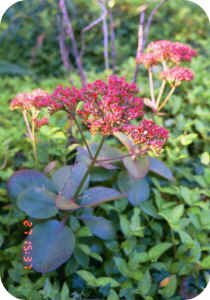
Q: I got a kalanchoe plant as a Christmas present. It has white flowers on it. It said on the back of the tag that I have to keep the compost moist at all times. It also said I have to feed it every two weeks, but it didn't say what I have to feed it with, so I was wondering if you have any suggestions.

A: We love Kalanchoes. We used to have trays and trays of them that bloomed all winter long.

We just kept them moist, but not to over water. If the leaves begin to turn yellow, you are probably over watering. Soil moist to the touch, but certainly not soggy.

We never fertilized them, but one of our books says a balanced fertilizer. Something like Peter's 20-20-20 or a 10-10-10. Just follow the directions in mixing it up.

Q: Emily, I have a kalanchoe I received as a gift. Is this strictly a houseplant? I keep it by a window and under a light that stays on at night until I go to bed. However, all the large leaves died and dropped off. The flowers died also. I got the plant around Mothers Day. It was blooming. Can I put it outside now in the summer? Can I feed it " Miracle Grow, which is used for "azaleas" , which are acid loving plants. Thank you ,

A: The kalanchoe is such an easy growing plant that all of the "problem solver" books (like Rodale's or Southern Living) don't even mention it. We have our kalanchoe page in with "plants of the week" instead of "weed of the week" because of our kind nature.

We put all of our houseplants including the kalanchoe outside for the summer. They are tolerant of sun, heat, etc.

Kalanchoe daigremontiana bloomsQ: My grandparents gave me a Kalanchoe for a gift about 3 years ago, it is in the same pot and growing tall and very pretty. My question is how would I transplant it to make Kalanchoe plants. It is starting to get it leaflets now, do I put those in water or soil, or do I let them grow with the plant to make it fatter.

A: Propagating a Kalanchoe is easily obtained from the leaflets, lay on top of some light sterile soil.....

That should do the trick.

You can also cut off any arms or stems that have grown and propagate in soil.......

This is a succulent so be light on the watering ....

Spring is a good time to start all of this although I have done a lot during late winter ....

Kalanchoe bloomsQ: Em - Hi, I live in the southeast part of Michigan. I received a Kalanchoe last Christmas 2002. I barely do anything for this plant other than water it when it is "bone dry" and pinch off the leaves that start to look brown and dry. Sometimes I pick off the old blooms too. My plant has flowered all year long (there are four thick stems in my pot). I keep it at a window facing the south. I really have no problems with it at all, but I think it needs a bigger pot. Can I split the four stems up and re-pot them individually? Or should I just find one very large pot? And, when should I do this?

A: It is really your preference to the repotting. Since it is pot bound and you have had fun and taken good care of it as one plant.... you may just prefer keeping them all together and growing up one large plant. You have taken excellent care of it.

The job of splitting (dividing) it up is for sharing and making lots of new plants to take care of.

I might add if you repot at this time of the year you might not get a new blooming period come Jan or Feb (when they normally bloom).. It may just go out of sync for you...but if that is not a concern repot.

Kalanchoes are very hardy and repotting anytime of the year is ok....

They are succulents and your watering patterns are perfect.

Do not fertilize after repotting for a bit and cut back normally for the winter months in any case.

Q: My mother had a plant. It was dark green. Leaves were kind of thick and jagged like a saw. It grew little baby plants on its ends and they would drop and continue to grow in other plants or the same pot, and would do the same.

She had the plant for years and it grew very tall. It was not a tree and it never had flowers. It looked like an alligators mouth because of the jagged edges all the way around.

Do you have any idea what this plant is??? She thought it was a colancho, but I cannot find it on any web pages.

A: I believe form your description that you have a Mother of a thousand Babies. It is a Kalanchoe and grows from what you describe.

Q: I live in a very hot climate (Houston, TX), and I have a number of Kalanchoe plants out in my patio garden - some in pots, some in a small flower bed. Some get direct sun some of the time, some are in complete shade. All of them look very healthy, they all grow like weeds, I just have to stick a cutting in the bare ground or a pot and it will take root and grow like crazy. But, after the first flowering is over, none of them has ever put out any more buds, and none of my plants from cuttings has ever budded at all.

So, what can I do to get them to bud again? I like the green, and they will thrive where nothing else will grow in my patio, but I would love to have all those gorgeous colors again.

A: Yes, kolanchoes grow well in your area of Houston. They will grow in sun and shade....some winter over others might get hit by a cold day or two in the winter . I lost a lot of mine from the cold this past winter . Generally cold will turn them to mush.

However they only bloom once a year for the most part. And that starts in February. Once the blooms are finished about 4 months later and they are old and crusty, pinch them off and concentrate on growing a good healthy plant for next year. If it gets tall and lanky prune back and replant the cutting for a new plant. If your plant is pot bound, by all means pot it up into a larger size. Fertilize on a regular monthly basis.

There is a bloom enhancer fertilizer 10-60-10 and this may make bigger and better blooms. Do not use until next Jan and February.

Hope this helps a little.

Q: We live in the south Texas area - about 45 min. north of Houston. I occasionally see Kalanchoe in outdoor plantings. Will it tolerate our intense heat in the summers and still keep flowering? It seems to survive our winters and also tolerates some shade.

A: Yes, Kalanchoes tolerant plenty of heat, they are a succulent and is drought tolerant.

It's flowering period is from February for about 3 months or so. Then it needs a rest period.

Q: HELP! This Kalanchoe was sent from some very dear friends for my dad's funeral. It's losing the flowers and seems to be dying! Is it a normal process that these flowers wilt/die or should I trim them off? The leaves seem nice and green...I have it inside and try to place it directly in the sunlight by the window or even outside during the weekends to give it sunlight. What am I doing wrong? I keep feeling the soil to make sure it is not too moist or too dry. Please help - this plant means so much to my family and me.

A: Yes, trim the flowers off. Kolanchoes are succulents that require wet-dry watering. (Water well and then wait 'til it is bone dry and water again.) Good bright light and they will tolerate full sun.

Summer the plant out for the season.
Fertilize once a month.
Repot when it is pot bound to a one or one in a half size bigger .

It should be ok.

It grows best in a clay pot. If you do not like the look of a clay pot, double pot it. (Meaning take your clay pot and just set it inside a more decorative one.)

Q: I had a wonderful Kalanchoe at the end of the summer...starting from a 1 1/2 inch pot...the plant was almost 12" tall and wide....I brought the plant indoors before frost..and only water when the soil is dry..but leaves drop every day...should I cut the plant back to short stems and let it start over? The plant continues to grow new leaves but has empty stems below the new growth.

A: Kalanchoe are succulents that do not require a great amount of water. They may even perform better by a wet to dry watering schedule. Going bone dry to watering well but not with wet /soggy roots.

For those leaves that do not look good, you may pinch off. Do not fertilize 'til the spring, when you can summer outside again.

Kalanchoe are hardy plants and should bounce back for you in better conditions.

They do enjoy good bright light and will tolerate full sun at times ....

My guess is to water less...

Q: My biology class is doing a project in which we must grow the Kalanchoe for a period of about 5 months. When we turn in the pant he will base 50% of the grade on how well the plant grew. I was wondering if you would be able to give me some insight on the optimal way of taking care of this plant. I live in Maryland so the plant is going to have to stay inside during the winter months. I've heard that miracle grow and nitrogen can harm the plants roots... Is this true and if so are there any alternatives?

A: Kalanchoes are succulents. Good bright light and perhaps even a sunny window will help in the winter. They will probably bloom in February for you.

Do not over water and especially in the winter time do not over fertilize. A little miracle grow each month should be ok. A little!

A sandy soil or a lighter soil should work for you. They actually adapt to any kind of soil.

Growing in a clay pot will be easier for the plant because it will dry out in between watering a lot easier.

Q: Is a Kalanchoe a houseplant or an outside plant?

A: That depends on where you live. There is no such thing as a 'real' houseplant. Every plant lives naturally and normally somewhere on this planet. A Kalanchoe is native to subtropical and tropical Africa and Madagascar, and scattering species in Asia. So in these parts of the world they do grow outdoors as a perennial succulent., climbers and sometimes shrubs. However, in cooler zones one can grow this plant as a houseplant and summer outside 'til just about frost.

Kalanchoes requires good bright light if not full sun and not the best of soil nor fertilizing......

Growing them in clay pots and simulating their native habitat makes for a nice 'houseplant' .

[back to Plants of the Week]

©2000, 2001, 2002, 2003 by Emily Compost, all rights reserved.
Emily's privacy policy